
Just the right pressure. A fraction of a second. An intact product.
Ultra High Pressure Homogenization (UHPH) is a liquid processing technology that revolutionizes the concepts of sterilization and homogenization as we know them. Developed and patented by Ypsicon Advanced Technologies in collaboration with the Universitat Autònoma de Barcelona, UHPH represents the most significant technological leap in fluid processing in the last fifty years.
What is UHPH?
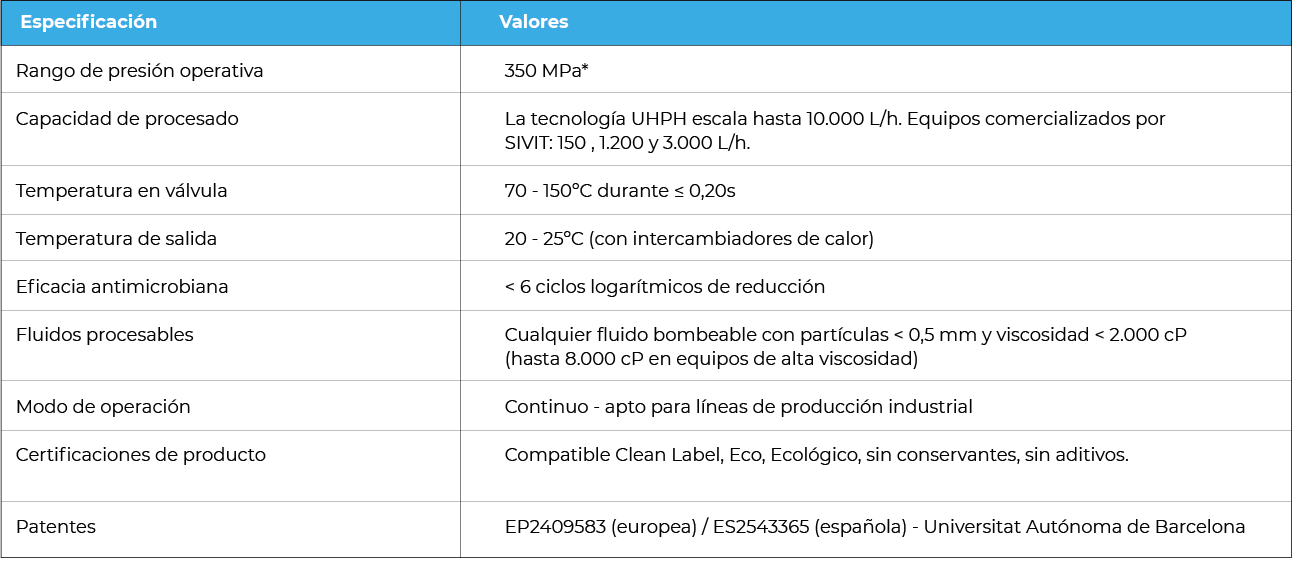
UHPH involves continuously pumping a fluid up to pressures of 350 MPa* (megapascals) and instantly decompressing it to atmospheric pressure as it passes through a specially designed homogenization valve. Exposure to the thermal peak lasts less than 0.20 seconds.
At that instant, inside the valve, extraordinary physical forces are unleashed: impact, extreme shear, and cavitation generate submicron fragmentation of biological tissue in a range of 100 to 300 nm. The antimicrobial effect is highly effective, achieving reductions greater than 6 log reductions†, even at low inlet temperatures.
At valve temperatures of 140-150°C (for only 0.20 seconds), it is even possible to destroy heat-resistant spores, opening the door to commercial sterilization of products previously impossible to stabilize without prolonged heat.
How it works: the step-by-step process
1
PREHEATING
The product enters the system and is conditioned by heat exchangers, preparing it for treatment.
2
ULTRA HIGH PRESSURE PUMPING
An ultra-high pressure pump continuously raises the fluid to pressures of up to 350 MPa*.
3
UHPH VALVE
The core of the technology. The fluid passes through the homogenization valve specially designed by Ypsicon. In less than 0.20 seconds, the physical forces that cause microbial inactivation and submicron fragmentation are produced.
4
INSTANT COOLING
After the valve, the product is immediately cooled by heat exchangers, reaching outlet temperatures of 20-25°C.
5
ASEPTIC FILLING
The sterile product is ready for aseptic packaging.
The UHPH process in video
Video provided by Ypsicon, manufacturer of UHPH equipment.
Advantages over conventional technologies
vs. Pasteurization (HTST)
- No thermal damage — valve temperature is high but instantaneous (0.20 s)
- Longer product shelf life at room temperature.
- Superior preservation of aromas, vitamins, and bioactive compounds.
- Reduction or elimination of sulfites in wines and cavas.
vs. UHT Sterilization
- No 'cooked' flavor or protein degradation.
- Final product with a sensory profile much closer to fresh.
- Compatible with heat-sensitive ingredients and additives.
vs. HPP (High Pressure Processing -Isostatic High Pressure)
- Continuous, not batch process — suitable for large industrial volumes.
- Simultaneous homogenization — no additional process required.
- Competitive cost per liter in large-scale production.
- Longer product shelf life at room temperature.
- Compatible with all packaging systems.
System technical specifications
Scientific backing
UHPH is not a commercial promise. It is proven science. More than two decades of research at the Universitat Autònoma de Barcelona, with the participation of the group led by Prof. Buenaventura Guamis, have resulted in a technology validated in hundreds of studies, international publications, and projects with European funding.
- More than 30 scientific publications indexed in top-tier international journals.
- Recognized by the International Organisation of Vine and Wine (OIV) for the production of sulfite-free wine and the preservation of must.
- Projects with funding from EIT Food (European Institute of Innovation & Technology)
- Applied in research with donor human milk, pharmaceuticals, and high-demand cosmetics.
Frequently asked questions about the technology
Is UHPH safe for all types of liquids?
Yes. UHPH can be applied to any pumpable fluid with particles smaller than 0.5 mm and viscosity lower than 2,000 centipoise (up to 8,000 in high-viscosity equipment). This condition covers the vast majority of liquids in the food, pharmaceutical, and cosmetic industries.
Does the heat in the valve not damage the product?
The exposure time is so brief (< 0.20 seconds) that heat-sensitive compounds do not have time to degrade. The technology is classified as ‘gentle’ despite the high peak temperatures. Tests demonstrate superior preservation of aromas, vitamins, and bioactive compounds compared to any conventional pasteurization or sterilization technology.
How is it integrated into an existing production line?
UHPH equipment is designed to integrate into existing production lines. Depending on the model and service modality, the installation can be modular, semi-mobile, or fixed. Our technical team conducts a preliminary process analysis to ensure optimal integration.
What maintenance does it require?
UHPH equipment is designed for demanding industrial environments. Preventive maintenance is performed according to established protocols. SIVIT offers maintenance contracts and remote and on-site technical assistance throughout Europe.
* Pressure adjustable according to process needs and sterilization objective.
† Result demonstrated in tests; varies depending on the reference microorganism and product.